

Updated: October 16, 2026
Our customers tell us their buyers are active everywhere. They also tell us their lead and account scoring isn't.
Most scoring models only account for "traditional" buyer activities. Think website visits, form fills, product sign-ups, and email opens, easily trackable behaviors that align with a linear sales funnel.
But the modern customer journey isn't linear. It zigs and zags across digital channels, most of which organizations have limited or zero visibility into.
That means the majority of scoring models are missing crucial buying signals (there's a reason up to 90% of marketing-qualified leads never turn into sales-qualified leads, according to Crunchbase).
But that's not all. Most lead and account scores are a black box go-to-market teams can't crack.
We hear it on sales calls constantly: reps spend 70%+ of their time on research and admin, and buyers increasingly ignore generic outreach. Email response rates sit around 1%, and call connect rates hover around 2.5%.
Data teams devise complicated scoring systems and push them into production using predictive analytics solutions. They tell reps whether a lead is "good" or "bad," but they don't tell them why or how to follow up.
The GTM landscape is tougher than ever. Reps can't afford to make decisions based on incomplete data with no context.
They need to go to market intelligently.
That's why we're excited to introduce Common Room's new signal-based lead and account scoring. Our customers are seeing a 2-3x lift in propensity-to-buy by scoring across all signals available in Common Room. As a comparison, a form fill to talk to a sales rep results in a 4x lift.
Our contextual, intelligent scoring empowers GTM teams to:
- Evaluate leads and accounts using every available first-, second-, and third-party signal generated by Common Room and captured by your existing solutions to get to the most comprehensive score possible.
- Spotlight exactly why leads and accounts were scored the way they were so reps can use that context in their messaging.
- Replenish opportunities in real time by automatically adding high-scoring leads and accounts to dedicated outreach lists.
- Automate plays based on lead and account scores to support contextual outbounding at scale.
What Is Account Scoring, and How Is It Different From Lead Scoring?
Account scoring ranks whole accounts, and the buying groups inside them, by ICP fit and buying-signal activity. It answers a simple question: which accounts should your team work first?
Lead scoring, or person scoring, works at a smaller grain. It ranks individual people by their own behavior, while account scoring rolls those people up to the company they work for.
Here's where most tools fall short. Intent platforms stop at the account level, telling you "Acme Corp visited your pricing page" without revealing which person is actually in market.
Common Room's signal-based account scoring works at the person level, then rolls up to the account. You see not just which company is interested, but who.
More Signals Mean More Accurate Account Scoring
It's not that the signals used in standard scoring models are bad. They're just a small slice of the pie.
A lot more goes into purchase decisions than website visits and product usage.
There are conversations on LinkedIn and X, questions in Slack and Discord, keyword mentions across Reddit and Discourse, actions in GitHub and DEV, and hundreds more.
Common Room enables you to customize your lead and account scores based on any combination of signals across our built-in signals or any one of our 50-plus signal integrations.
Pull in data from your product, CRM, and website and combine it with signals from social, community, open-source, and beyond to see the full buyer picture.

More context means better outreach
Knowing that a lead is "good" isn't good enough.
Reps don't need yet another MQL tossed over the fence. They need visibility into the actions and attributes behind the score to plan their approach and tailor their messaging.
Common Room's Person360™ reveals the individuals and organizations behind the signals so you can connect cross-channel activities to real people and real accounts.
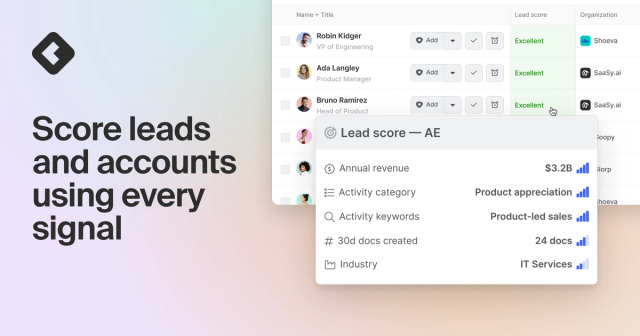
The behaviors and characteristics that drive scores are just a hover away, no sleuthing required.
Reach out to the right person with the right message at the right time based on the complete picture of their intent and fit.

Add intelligence minus the complexity
You can set up scoring in Common Room in a matter of minutes.
We automate digital signal capture, as well as identity resolution and enrichment. All you have to do is select which signals matter most to you and your organization.
Here's how it works:
Click Add rule and select the signal or attribute you want to incorporate into your scoring model. Weight the importance of the signal or attribute using a sliding scale.
You can decide how much of the score should focus on behavior, specifically the actions and conversations happening across channels, versus fit, meaning your qualification criteria.

Customize which score ranges count as "Not a fit," "Fair," "Good," or "Excellent" based on your own internal guidelines. Preview how people and accounts are distributed across different score ranges and tweak score thresholds until you're satisfied.

Once scoring is set up, you can jump from a high-scoring lead to a unified profile for that person or account in one click. Instantly see job titles, recent funding, company size, tech stack configuration, and any other enriched characteristic you care about.
GTM teams simply hover over a score to see which factors are driving it. This way, teams get the full context for what's powering a score so they can personalize outreach accordingly.
You can also use scores as filters for Common Room's automated alerts, segments, and workflows.
Teams can automatically get notified when a lead with a high score is surfaced, add them to a dedicated segment for monitoring and engagement, and send them to their marketing automation platform or sales engagement tool of choice.

Our integrations with your preferred martech and salestech mean you can run end-to-end go-to-market strategy from one place, no context switching necessary.
Common Room's signal-based lead and account scoring gives you everything you need: the who, what, where, when, why, and how, all in one place.
Start scoring leads using every signal, everywhere, today. Learn more in our docs.
Sell smarter using signal-based lead and account scoring with Common Room
Request a demo to see how Common Room can help you build a better account scoring system.
FAQs
What is account scoring?
Account scoring ranks whole accounts, and the buying groups inside them, by ICP fit and buying-signal activity. It answers which accounts your team should work first, using every available first-, second-, and third-party signal rather than just website visits and form fills.
How is account scoring different from lead scoring?
Lead scoring (or person scoring) ranks individual people by their own behavior. Account scoring rolls those people up to the company they work for. Most intent platforms stop at the account level; Common Room's scoring works at the person level first, then rolls up, so you see not just which company is interested, but who.
What signals go into an account score?
Any combination you choose: first-party data from your product, CRM, and website, plus second- and third-party signals from social, community, open-source activity, and Common Room's 50-plus signal integrations. You weight behavior versus fit on a sliding scale to match your own qualification criteria.
How long does it take to set up account scoring in Common Room?
Minutes. Signal capture, identity resolution, and enrichment are automated, so setup is a matter of selecting which signals and attributes matter to your team and weighting them, then previewing how people and accounts distribute across your score ranges.
How do reps act on a score instead of just seeing it?
Reps can hover over any score to see exactly which signals and attributes are driving it, jump to a unified Person360 profile in one click, and use scores as filters for automated alerts, segments, and workflows that route high-scoring leads straight to a sales or marketing tool.